
Dispatches · No. 11 · Announcement ·
Medicine, Continuity and the Limit at the 4th Peking University International Conference on Health Humanities
Christian Schulz-Quach gave a plenary lecture at the 4th Peking University International Conference on Health Humanities in Beijing on 8 November 2026, asking what happens to finitude when medicine’s technologies of continuity succeed, and what this asks of the people who give and receive care.
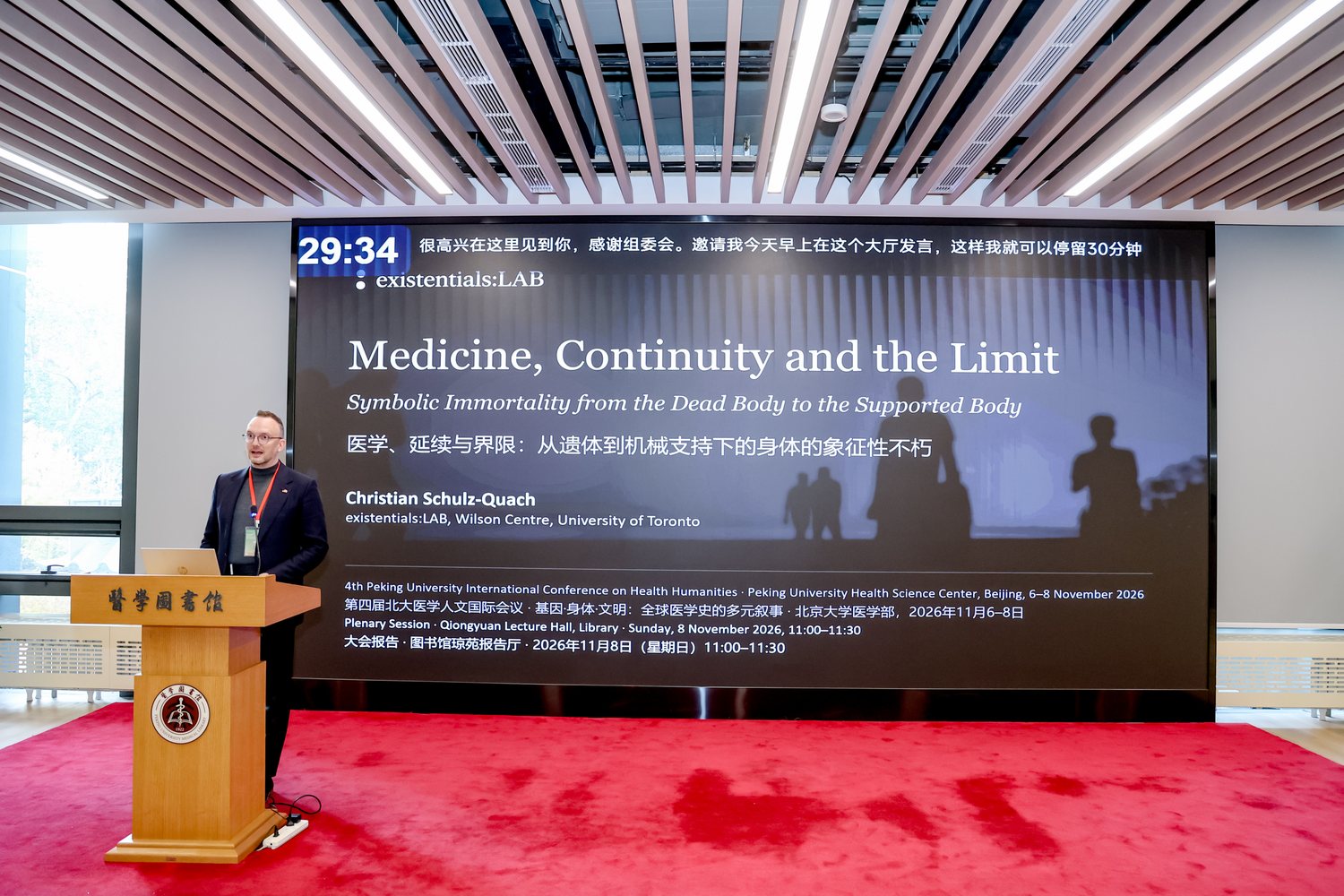
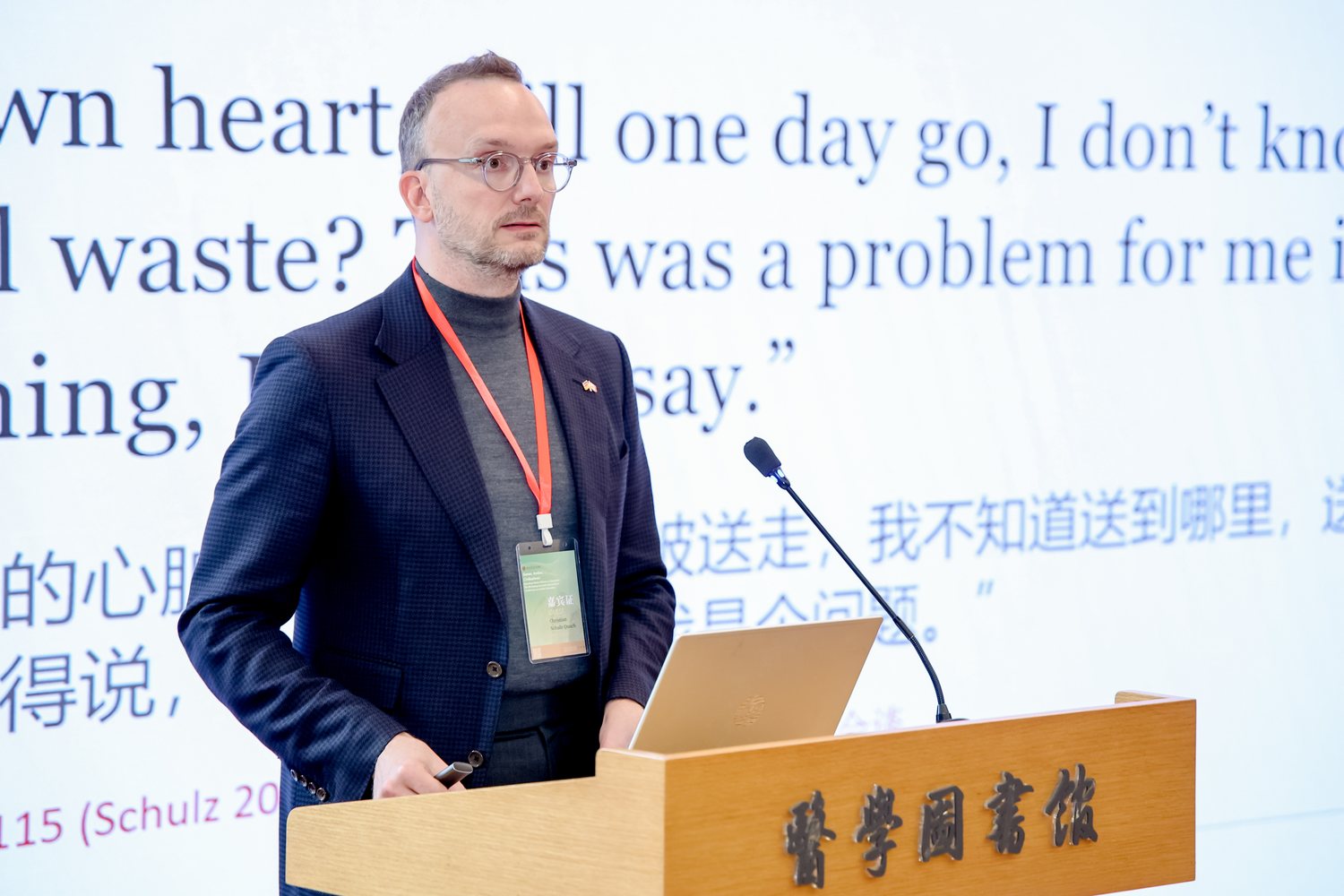
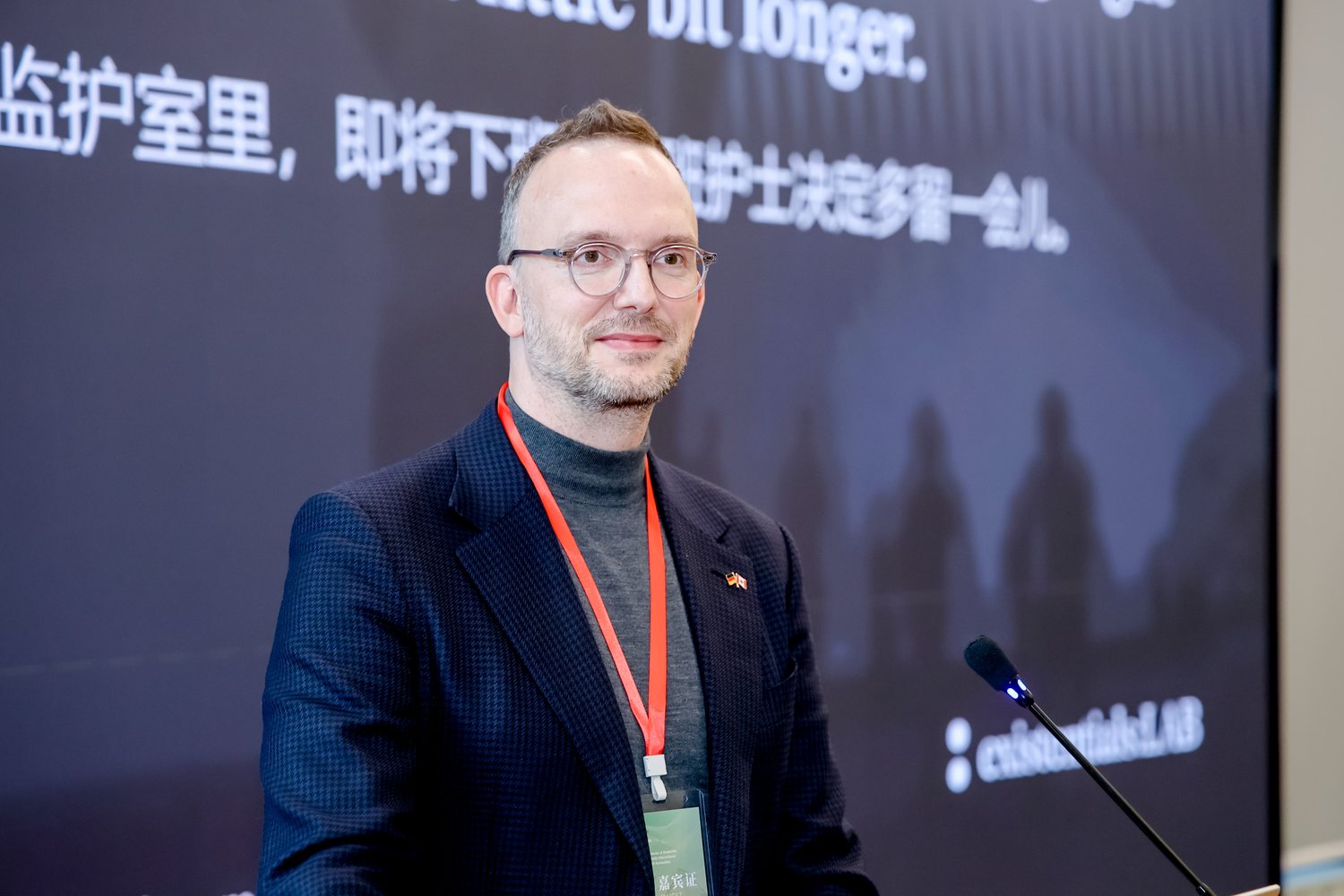
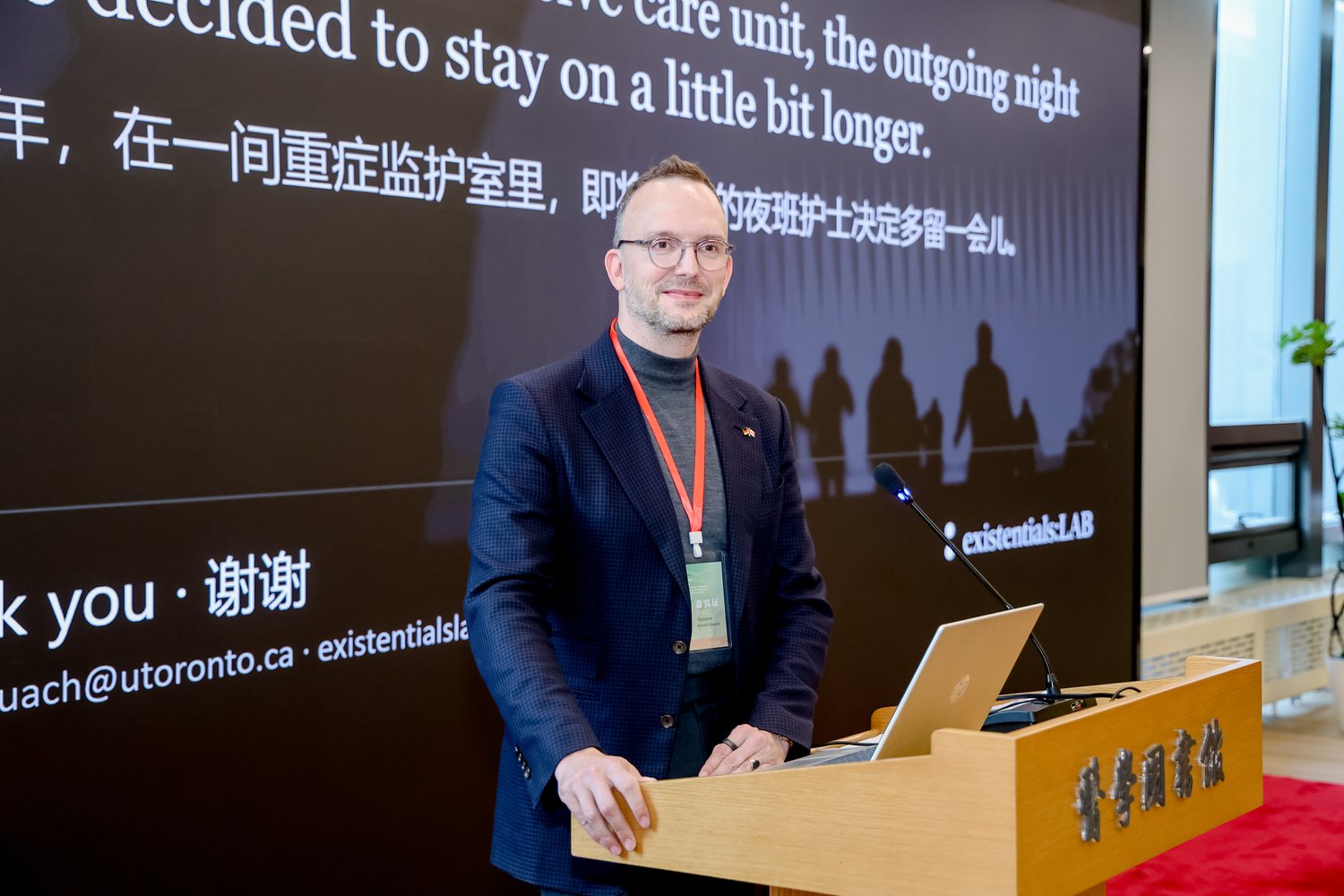
On 8 November 2026, Christian Schulz-Quach gave a plenary lecture at the 4th Peking University International Conference on Health Humanities, hosted by the School of Health Humanities at Peking University Health Science Center in Beijing under the theme “Genes, Bodies, Civilizations: Narrating Global Histories of Medicines”. The session, in the Qiongyuan Lecture Hall of the University Library, was chaired by Lai Lili. The lecture was given in English with bilingual English and Chinese slides; the programme lists it under its submitted title, “Medicine as a Technology of Continuation: Symbolic Immortality from the Corpse to the Genome”.
The lab’s question at medicine’s most successful edge
existentials:LAB asks how healthcare professionals make meaning of problems that cannot be re:solved, only worked with. The lecture put that question where medicine succeeds most visibly. Assist devices, transplants and, beyond the clinic, programs that simulate the dead are technologies of continuity: they sustain, replace or simulate a failing function, and they do much of what they promise. What becomes of finitude when they succeed, and what does this ask of those who give and receive care?
A limit that can only be worked with
The lecture opened with Sarah, who at thirty-five lived with a left ventricular assist device while waiting for a heart transplant, and who asked what would become of her own heart: “My own heart, will one day go, I don’t know where, to a special waste?” Karl Jaspers called such questions limit situations (Grenzsituationen): death, suffering, struggle, chance and guilt, which remain essentially the same even if their momentary aspect changes. In the lab’s terms, they cannot be re:solved, only worked with.
The lecture’s claim is that technologies of continuity leave the limit situation in place, and that their very successes move it to new occasions and new forms. In his 1958 lecture to physicians, Jaspers distinguished the Grenze, the boundary of what natural science can do, from the limit situation itself. The boundary keeps moving, from surgery “into lungs, heart and brain” to assist devices and transplants, and the limit situations travel with it. The lecture proposed a way of hearing whether the limit is veiled or met: whether the promise of a technique is taken to have removed the limit, or whether the limit can still be spoken of while the technique goes on working.
Three scenes, three lines of inquiry
Formation. In 2003, on an intensive care unit, an outgoing night nurse stayed on and invited Christian, then a medical student, to help wash the body of a person who had died. Read with Marcel Mauss’s idea of techniques of the body, washing is a technique as much as a pump is, and the same technique can accompany the dead or hurry past them. What a clinician learns at such a bedside is passed on in the way an experienced colleague chooses to use it.
Enactment. In Sarah’s published therapy, chance arrived in the battery pack and struggle arrived at work, when her camera set was given to a colleague. Her own words held both veiling and its undoing: “your heart is special, but then somehow it isn’t.” The transplant went very well, and her life now also depended on the death of a donor she did not know. In China, when the Interim Measures on anthropomorphic AI services took effect on 15 July 2026 and several platforms withdrew their agent functions, users who had built agents of deceased relatives described, in reporting by The Paper (澎湃新闻), a “second farewell”. Where does grief go when a continuity that had deferred it is withdrawn?
Method. The clinical material came from published heuristic studies, in which the researcher’s own experience is part of the data. In the Chinese scene, Chinese scholarship led the discussion, including the work of Zhang Aijun and Jiang Yu, and Wang Zhenhui’s proposal of a “digital sacrifice” grounded in Confucian mourning. Where the lecture extended Jaspers, it named the extension as its own question.
Responsibility at the limit
Following Jaspers, the lecture located the clinician’s part in the guilt that cannot be avoided and in the responsibility of taking it upon oneself, staying beside the patient without claiming the patient’s place. What remains open for medicine is how its techniques are used when the limit arrives, and who stays in the room.
A note from the lab
The lecture brings the Founding Director’s clinical scholarship into conversation with health humanities in China, and states a question the lab will keep working with: how clinicians are formed to meet the limit when their techniques succeed, and how institutions hold what those techniques cannot re:solve. Readers interested in the written paper are welcome to write to the lab.
We thank the organizing committee and the School of Health Humanities, Peking University, for the invitation; Lai Lili for chairing the session; and Yingtan Su (苏映潭) of the organizing committee for her careful reading of the Chinese slides, including the rendering of Grenzsituation as 临界情境.